History without trust
Agent transcripts mix facts, guesses, drafts, and abandoned paths.
Keep evidence, claims, acceptance, and supersession as separate records.
CarpeOS captures agent sessions with provenance, compounds verified meaning through a post-capture agentic layer (quality-filtered, multi-host), and returns promoted knowledge — with status explicit and the trail intact.
Public code. Private knowledge. Not hosted SaaS.

A real decision, a rejected approach, or a bug path often ends up split across chat history, terminal scrollback, and notes. CarpeOS keeps the trail without treating every statement as “memory.”
Agent transcripts mix facts, guesses, drafts, and abandoned paths.
Not every lifecycle event should become searchable meaning.
Each coding tool starts with a different memory of the work.
Generated documents drift until no one knows what was canonical.
Provider hooks feed a private event store. A precision-first adjudicator assigns promote, hold, or reject. Default retrieval returns promoted meaning; MCP, CLI, and projections remain interfaces — not the source of truth.
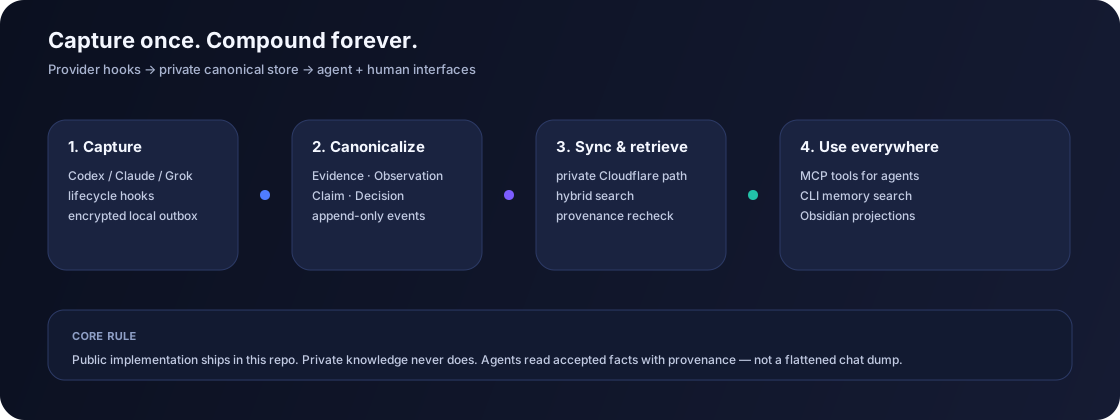
Selected lifecycle events enter an encrypted outbox and local store. Host hooks stay fail-open and fast.
Rules and the post-capture agentic plane assign promote, hold, or reject. Verified decision, constraint, and preference meaning can promote without load-bearing HITL; nothing auto-accepts a claim.
Default search is promoted and active only. Local hybrid ranking boosts typed promoted units; results stay bounded with provenance rechecked.
People and agents work through CLI (including carpeos agentic), local MCP, Obsidian notes, and OKF export projections.
Interfaces are local and share the same underlying model. Projections can be deleted and rebuilt; they never become the canonical store.
Install hooks across hosts, flush the agentic feed, retract with human confirmation, rebuild retrieval indexes, and build bounded context packs from promoted meaning.
carpeos agentic flush · memory search · okf export
Search, trace, timeline, related records, graph neighborhood, capture, and propose claims through a local stdio server.
memory_search · memory_neighborhood
Fail-open feed after capture. Promote when verified for decision, constraint, and preference; near-duplicate promote holds; denser multi-host signal extract. Timer or flush; never auto-creates AcceptanceDecision.
carpeos agentic timer|flush|retract
Export a trust-zone-scoped, promoted-by-default OKF v0.2 bundle. Export only — not an import path or canonical store.
carpeos okf export|rebuild
CarpeOS preserves the difference between what was observed, what was proposed, what was promoted into active meaning, and what was later replaced.
CarpeOS requires Node.js 22.22 or newer. The setup flow shows resolved paths and actions before it changes anything. Pin @innocarpe/carpeos@6.7.7 when you want a fixed release.
# install the published package
npm install -g @innocarpe/carpeos

# inspect actions first
carpeos setup plan

# apply runtime + MCP registration
carpeos setup run --apply

# install merge-safe capture hooks
carpeos setup hooks install --apply
Local-first. Interfaces ship on your machine; no hosted Worker, hosted MCP, or SaaS deployment is claimed.
The website stays intentionally small. Detailed contracts, guides, ADRs, and implementation status live with the public source.
A focused map of architecture, installation, capture, adjudication, retrieval, and MCP references.
Open locally System designFollow the event model, trust boundaries, storage layers, and projection rules.
Read on GitHub Agent interfaceReview the local stdio tools and the contracts agents can rely on.
Read on GitHub